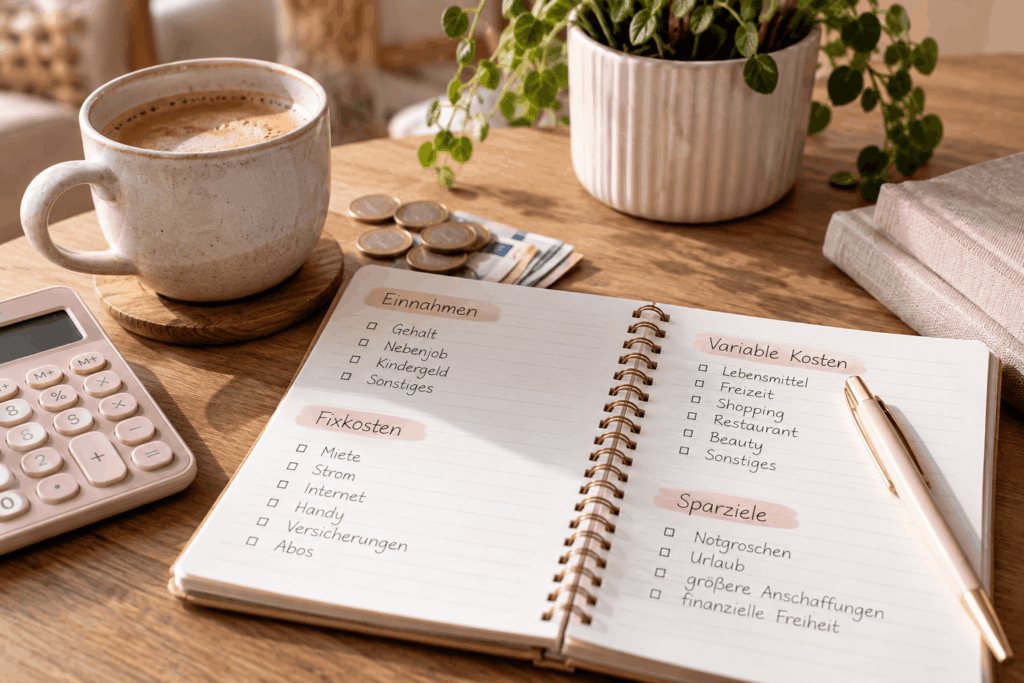
Plan a budget: This way you have more money left over at the end of the month
20. October 2026
Planning a budget instead of wasting money: This is how it works
Do you know that?
At the beginning of the month the money comes into the account and for a brief moment everything feels pretty relaxed. Rent paid, bills taken care of, maybe even a little money put aside. Running.
And then… somehow not anymore.
Ordered something quickly here, got a coffee there, bought groceries in between and oh yes – of course you completely forgot about this one debit.
Suddenly the month is far from over, but the money somehow is.
Oh my God. Where did it all go?
This is where a budget comes into play.
A budget shouldn't ensure that you spend every penny three times and don't even treat yourself to a coffee at the end of the month. On the contrary: good budget planning should show you where your money actually goes and how you can use it more consciously.
Because planning money doesn't automatically mean living less.
It means spending less haphazardly.
And that's a pretty big difference.
Appropriate internal link: Here you could click on an existing article on the topic “Financial Freedom”, "Save money" or “Money Mindset” link.
Why your money disappears faster than you think
The problem is usually not the large expenses.
Of course – if a car repair, a high bill or a major purchase suddenly comes up, it can really hit your budget.
But in everyday life it's often the many small expenses that add up.
5 € here.
12 € there.
Something quick at the bakery.
An order because you actually “just wanted to take a quick look”.
And of course the famous one:
“Oh come on, I’ll treat myself to that now.”
Once it's not a problem at all.
But when the single “I treat myself” turns into ten small expenses per week, things suddenly look different.
The common thing about it: Individual amounts usually don't feel like a lot of money.
That's exactly why it's worth looking not just at the big bills, but at the entire picture.
A small example
Imagine you spend an average of €5 on small things every day.
These can be snacks, drinks, spontaneous purchases or small online orders.
€5 seems harmless at first.
But over the course of a month a lot comes together.
And that's exactly why a budget planner can be so helpful: you don't have to guess where your money is going.
A budget is basically nothing more than a plan for your money.
You think about it beforehand:
How much money comes in?
What fixed expenses do I have?
How much do I need for my everyday life?
How much do I want to save?
And especially:
How much can I actually spend freely?
That sounds pretty boring at first.
But it is precisely this overview that can be incredibly relieving.
Because if you know that, for example, €150 is budgeted for leisure, shopping and other wishes, you don't have to think about it every time you go shopping:
“Can I actually afford this now?”
You have already given your money a place to go.
And that’s what a budget is all about.
Not about banning you from everything.
But because to give your money a plan.
Step 1: Find out how much money you really have available
Before you start with savings goals and challenges, you should first know how much money you actually have available.
Write down your regular income.
These can include, for example:
Salary
Part-time job
Self-employed income
Child benefit
Maintenance
other regular income
It is important that you do not calculate with a desired amount, but with the money that is actually available to you.
Because a budget only works if it is realistic.
For example, if you have $1,500, you shouldn't pretend you have $2,000.
Sounds logical.
We all do it sometimes though. 😅
Step 2: Write down your fixed expenses
Now things get interesting.
What costs come up pretty reliably every month?
For example:
Rent
Electricity
Internet
cell phone
Insurance
Subscriptions
Loan installments
Memberships
regular contracts
Look really closely here.
Especially with subscriptions, it can quickly happen that you continue to pay for things that you actually hardly use anymore.
Streaming service number 1.
Streaming service number 2.
Gym, even though it's been three months since you've been "starting again next week."
And somewhere you might still have a trial subscription running that you've long forgotten.
Here you can actually find money without needing additional income.
Simply by checking your existing expenses.
Step 3: Don't forget variable expenses
Now we come to the area where the budget usually gets a little more chaotic.
Groceries.
Leisure time.
Shopping.
Restaurant visits.
Beauty.
Gifts.
Hobbies.
Transport.
And of course all the little things that you hadn't noticed before.
That's exactly why you should plan for these expenses.
A budget where you only pay your bills every month and enter €0 for everything else probably won't work for long.
Why?
Because you still want to live.
And that is completely normal.
A realistic budget therefore also takes fun and personal wishes into account.
Because A budget without room for living is usually not a realistic budget.
Step 4: Set your savings goal
Now comes the part where you can think about:
What do I actually want to save for?
Because “I should save more” is a good thought, but it is not yet a concrete goal.
What is much more motivating is:
“I want to save €1,000 for my emergency fund.”
Or:
“I want to use it to finance my vacation next year.”
Or:
“I want to build up financial reserves.”
A specific goal makes saving more tangible.
And suddenly “I’ll spend €20 less today” no longer just means “I’m not allowed to do that”.
Rather:
“I’m €20 closer to my goal.”
That changes the whole perspective.
Link tip: Here you could very well read an article about “Set savings goals”, “Build up a nest egg” or “Financial Freedom” link.
Step 5: Make your budget visible
Now comes my personal favorite part.
Don't make your budget just some number that disappears in a note-taking app somewhere.
Make it visible.
For example, you can use a classic budget planner for this.
In it you can record income, fixed costs, variable expenses, savings goals and your actual expenses.
The beauty of it?
You don't have to start from scratch every month.
You can compare:
What did I have planned?
What did I actually spend?
Where was I wrong?
And it is precisely these differences that are interesting.
Maybe you budgeted $300 for groceries but actually spent $370.
Then you know:
I have to take a closer look here.
Maybe it was only €250.
Then you know:
Okay, my plan is working pretty well here.
This means your budget will become more and more realistic over time.
Would you like to plan your budget clearly? A budget planner can help you track income, expenses, and savings goals in one place. This way you can see at a glance how much you have available each month and where you spend your money. You can find a suitable budget planner here.
The 30 Day Budget Challenge
And now let's turn it into a little challenge.
Because sometimes it's not enough to resolve:
“From now on I’ll spend less money.”
That sounds about as motivating as:
“From Monday I will only eat healthy.”
We all know how this ends. 😂
A challenge makes the whole thing more concrete.
Your 30 day budget challenge
Week 1: Observe
The first week isn't about saving perfectly.
You just observe.
Write every edition on.
Also the €2.50.
Also the coffee.
Also spontaneous online purchases.
Also the 8 € for something that five minutes later you no longer know why you actually bought it.
No self-blame.
Just observe.
Because you can only change something if you know what is actually happening.
Week 2: Question expenses
Now take a closer look at your expenses.
With every purchase you can ask yourself three questions:
Do I really need this?
Do I really want it?
Or am I just buying it spontaneously?
And no, you don't have to hold a philosophical seminar about every little thing.
But this little break can help, especially with larger or spontaneous purchases.
Sometimes you notice:
“Yes, I really want this.”
Then buy it.
Without a guilty conscience.
And sometimes you realize:
“Actually, I don’t need it at all.”
Then the €20 will remain in your account.
Both are completely okay.
Week 3: Choose a savings area
Now you're looking for yourself an area in which you want to save more consciously.
Not ten.
A.
Maybe it's delivery services.
Maybe shopping.
Maybe eat on the go.
Maybe unnecessary subscriptions.
Or maybe you notice that you regularly spend more than you planned when shopping for groceries.
Then you focus on that for a week.
This makes the challenge much more realistic.
Week 4: Optimize your budget
Now comes the exciting part.
You look at your past weeks.
What worked well?
Where have you consistently gone over your budget?
Which expenses were unnecessary?
Where would you like to consciously budget more money?
And what would you like to do differently next month?
The goal is not to end up with a perfect budget plan.
The goal is, to better understand your own handling of money.
Planning a budget doesn't mean you can't spend any more
I would like to make that very clear at this point.
A budget shouldn't be a prison.
If you only think about whether you can afford something every month, at some point the whole thing won't be fun anymore.
And that's exactly why I think it makes sense to consciously budget an amount for things that make you happy.
Maybe it's €50.
Maybe €100.
Maybe more or less.
That depends on your personal situation.
But if you know:
“This is my money for leisure and desires.”
you can also spend it.
Without always feeling like you've just ruined your entire financial future because you bought a new top.
After all, a budget does not mean:
Don't spend any money.
It means:
Spend money consciously.
What do you do if you still exceed your budget?
Spoiler:
It will happen.
At some point you will spend more than you planned.
Maybe you spend €80 on groceries even though your weekly budget is €60.
Maybe an unexpected bill comes.
Maybe you're just having a bad month.
This doesn't mean that your entire budget planning has failed.
Instead, look at Why you went over budget.
Was the amount unrealistic to begin with?
Was there an unexpected expense?
Or was it actually a spontaneous issue?
This distinction is important.
Because sometimes it's not your behavior that needs to be changed.
Maybe your budget just needs to be adjusted.
The most important mistake in budget planning
One of the biggest mistakes, in my opinion, is starting off too strict.
You set a huge savings goal.
You suddenly want to avoid all restaurant visits.
No more shopping trips.
No small rewards.
Save every cent.
And after two weeks you get annoyed and give up everything.
The problem isn't necessarily you.
Maybe your plan was just too extreme.
A good budget must fit your real life.
For example, if you want to save €100 every month but haven't saved anything yet, it may make more sense to start with a smaller amount.
You can always increase later.
Because financial habits don’t happen overnight.
They come from doing them over and over again.
Budgeting can even be fun
Yes I know.
“Budget planning” and “fun” are two words you wouldn’t normally expect to hear in the same sentence.
But actually, it can be motivating to see progress.
For example, you can set a savings goal and mark each month how much you have already accomplished.
100 €.
200 €.
500 €.
700 €.
And at some point, your target amount suddenly appears.
That's a pretty good feeling.
It will be even nicer if you not only look at your money, but also at what what the money allows you.
An emergency fund can mean more security.
Money saved can make a vacation possible.
Reserves can help you with unexpected costs.
And dealing with money consciously can be an important long-term step on the way to more financial freedom.
And dealing with money consciously can be an important long-term step on the way to more financial freedom. Because financial freedom doesn't just start with huge assets – it often starts with small decisions in everyday life. If you want to go deeper into the topic, you can find it more about financial freedom here.
Your budget doesn't have to be perfect
Perhaps that is even the most important insight.
You don’t need a perfect budget plan.
You need one that you actually use.
There's no point in spending two hours creating a beautiful budget in Canva if you never look at it again.
Your budget can be simple.
It can change.
And sometimes it may not work.
After all, you only learn what amounts are realistic for you.
After a few months, you will probably have a much better idea of how much you actually need for groceries, leisure or other areas.
And that's exactly when budget planning becomes easier and easier.
Conclusion: Give your money a plan
Money rarely just disappears.
Most of the time it flows somewhere.
The only question is:
Do you actually know where?
A budget can help you figure out just that.
You don't have to change your entire life right away.
Just start.
Write down your income.
List your fixed costs.
Watch your spending.
Set a savings goal.
And try the 30-day budget challenge.
You may find that you need to save a lot less than you thought.
But you might also find issues that make you think:
“Wait… I really spent money on this every month?”
And that's exactly where change begins.
Not with a perfect financial plan.
But with the moment you start to consciously look at your money.
Because in the end it's not about spending as little money as possible.
It's about, to have more control over how you spend your money.
And maybe today is the right day to start.
So: Budget planner out, coffee next to it and off we go. 😉